IML at MICCAI 2026: Best Paper Award and two contributions at EMERGE workshop

The Interactive Machine Learning (IML) department was represented at the 29th International Conference on Medical Image Computing and Computer-Assisted Intervention (MICCAI 2026) in Strasbourg, France. MICCAI is widely recognized as a leading international venue for medical image computing, computer-assisted intervention, and AI in medicine. 

At the MICCAI Student Board EMERGE Workshop – Empowering Medical Information Computing and Research through Early-career Guidance and Expertise, IML contributed two oral presentations addressing important challenges in multimodal medical AI and medical image analysis. 

Hasan Md Tusfiqur Alam presented “MedHyperGraph: EHR-Integrated Multimodal Hyperedges for Clinical VQA”, which received the Best Paper Award at the EMERGE Workshop. It introduces a multimodal hypergraph approach for clinical visual question answering that integrates imaging studies with structured and longitudinal information from electronic health records. Rather than simply increasing the amount of retrieved clinical text, the approach preserves temporal and higher-order relationships between clinical events. The results demonstrate the importance of structured clinical context for reasoning across longitudinal patient data.

Abdulrahman M. Selim and Hasan Md Tusfiqur Alam with the Best Paper Award

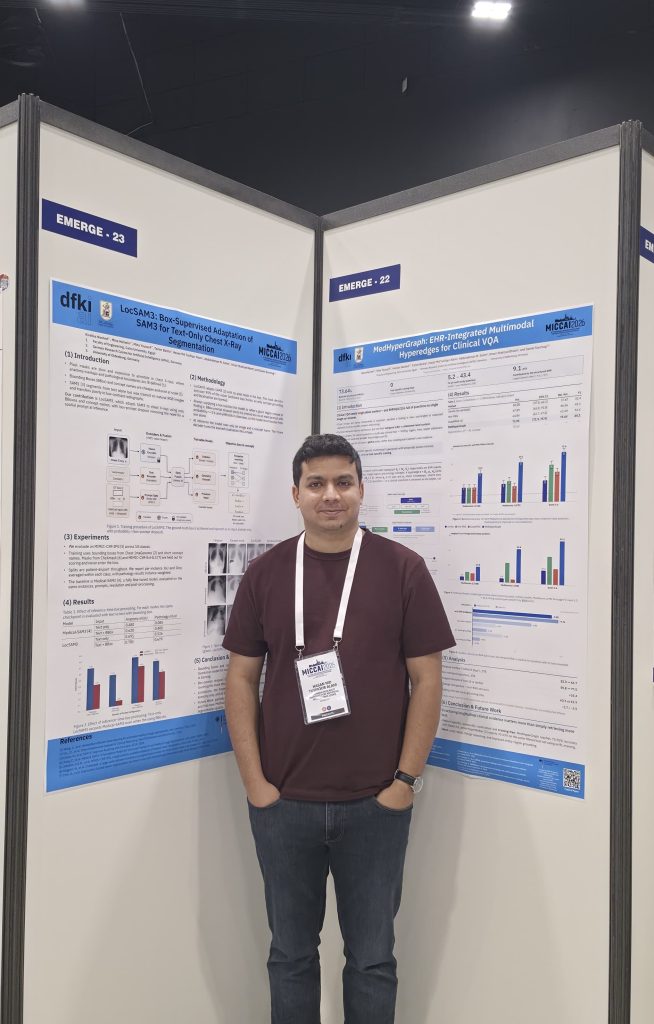
Hasan Md Tusfiqur Alam at the conference

Abdulrahman M. Selim presented “LocSAM3: Box-Supervised Adaptation of SAM3 for Text-Only Chest X-Ray Segmentation”, which investigates whether dense pixel-level annotations are necessary to adapt foundation segmentation models to medical imaging. LocSAM3 uses only bounding boxes and concept names during training and requires only an image and a textual concept at inference. The results show that coarse localization supervision can effectively support text-driven pixel-level segmentation of anatomical structures and pathological findings in chest X-rays. 

Together, the two contributions reflect IML’s ongoing research on multimodal medical AI, structured clinical reasoning, and data-efficient adaptation of foundation models, with the goal of developing medical AI systems that can make better use of heterogeneous clinical information while reducing costly annotation requirements. 

Congratulations to everyone involved, and especially to the MedHyperGraph team on receiving the Best Paper Award! 
Two Papers on Large Vision Models for Healthcare accepted at NeurIPS 2023

Duy Nguyen, from the Interactive Machine Learning department, and colleagues from the University of Oldenburg, Max Planck Research School for Intelligent Systems, the University of Texas at Austin, the University of California San Diego, and other institutions presented a full paper and a workshop paper at NeurIPS 2023. NeurIPS is considered one of the premier global conferences in the field of machine learning. The conference took place in New Orleans, USA, from December 10th to 16th, 2023, with an overall acceptance rate of 26.1%.

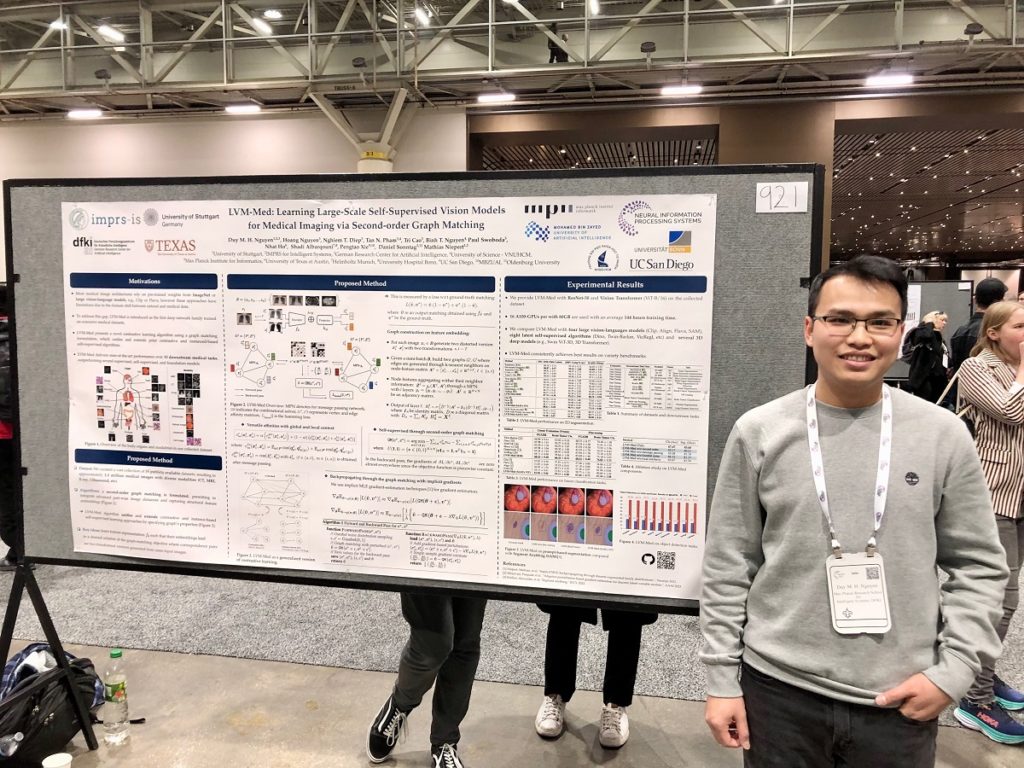
The first paper “LVM-Med: Learning Large-Scale Self-Supervised Vision Models for Medical Imaging via Second-order Graph Matching” introduces LVM-Med, a novel family of deep networks trained on a large-scale dataset of approximately 1.3 million medical images from 55 publicly available datasets (large vision model), encompassing various organs and modalities such as CT, MRI, X-ray, and Ultrasound. The authors address the challenge of domain shift between natural and medical images, proposing a self-supervised contrastive learning algorithm for fine-tuning pre-trained models. This algorithm integrates pair-wise image similarity metrics, captures structural constraints through a graph-matching loss function, and allows efficient end-to-end training using modern gradient estimation techniques. LVM-Med is evaluated on 15 medical tasks, demonstrating superior performance compared to state-of-the-art supervised, self-supervised, and foundation models. Notably, for challenging tasks like Brain Tumor Classification or Diabetic Retinopathy Grading, LVM-Med achieves a 6-7% improvement over previous vision-language models while using only a ResNet-50. Pre-trained models are made available to the community.

The second paper, “On the Out of Distribution Robustness of Foundation Models in Medical Image Segmentation”, accepted at the Workshop on robustness of zero/few-shot learning in foundation models (R0-FoMo), investigates the challenge of constructing robust models in medical imaging that can effectively generalize to test samples under distribution shifts. In particular, the authors compare the generalization performance of various pre-trained models after fine-tuning on the same in-distribution dataset, finding that foundation-based models exhibit better robustness than other architectures. The study also introduces a new Bayesian uncertainty estimation for frozen models, using it as an indicator to characterize the model’s performance on out-of-distribution (OOD) data, which proves beneficial for real-world applications. The experiments highlight the limitations of current indicators like accuracy on the line or agreement on the line, commonly used in natural image applications, and underscore the promise of the introduced Bayesian uncertainty, where lower uncertainty predictions tend to correspond to higher out-of-distribution (OOD) performance. 

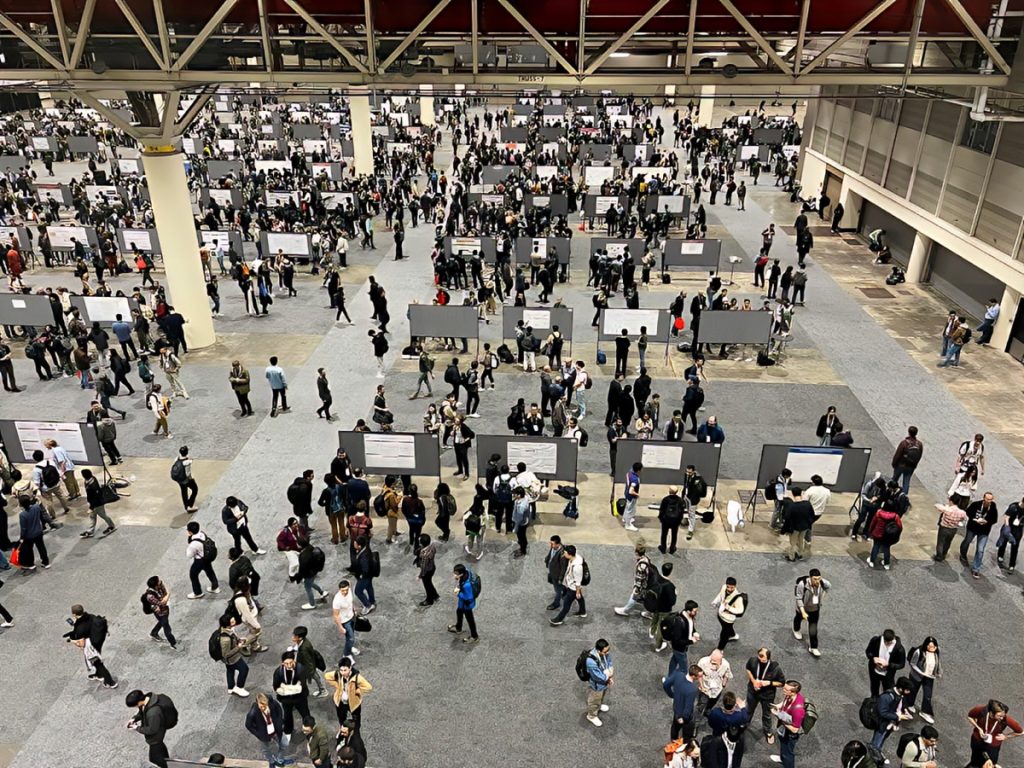
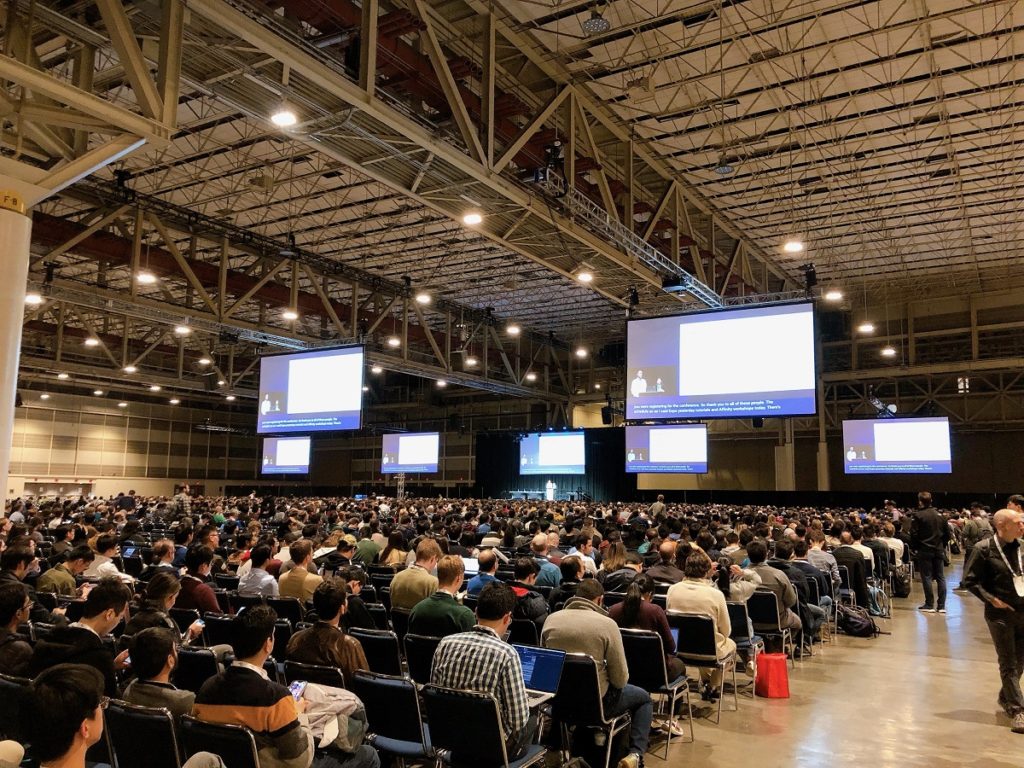
Like many previous NeurIPS conferences, NeurIPS-2023 this year features a diverse program with several invited speakers, 2,773 accepted posters, 14 tutorials, and 58 workshops. Among these, Duy reports important workshops for IML, for example, Foundation Models for Decision Making, Optimal Transport and Machine Learning, XAI in Action: Past, Present, and Future Applications, and Medical Imaging meets NeurIPS. Furthermore, our department connected and established collaboration for upcoming projects with leading groups in machine learning and bio-medical research at Harvard University and Stanford University.

Duy Nguyen with the poster explaining his paper at NeurIPS 2023

References

Nguyen, Duy MH, et al. “LVM-Med: Learning Large-Scale Self-Supervised Vision Models for Medical Imaging via Second-order Graph Matching.” arXiv preprint arXiv:2306.11925 (2023).

Nguyen, Duy MH, et al. “On the Out of Distribution Robustness of Foundation Models in Medical Image Segmentation.” arXiv preprint arXiv:2311.11096 (2023).